
It may be no more than a few scribbled notes on a Post-It, but every UAV development project starts out with some sort of list of requirements. For many projects, that list gets so long that you’re surprised to not find “the kitchen sink” somewhere in it.
I’ve found it is incredibly valuable at the start of any project to take a look at those requirements and determine, at least from an aero-mechanical perspective, which three or four requirements truly matter at the end of the day.
Usually most of the requirements are around items like payload integration features, communications options, or signal hardening, so the ones that affect the airframe design are just a subset. In theory that makes figuring out which ones matter most pretty easy, right?
But depending on how many stakeholders are involved and how many voices are in the room, that can be far more challenging than you expect. Some emphasize the cruising altitude of the aircraft as most critical; others couldn’t care less, as long as it can fly for their desired length of time.
It’s true that it’s the engineer team’s job to try to meet as many of those requirements as possible. But it’s also their job to determine which ones are more of wish list items, and which are the true make-or-break capabilities of this vehicle.
Why choose these “critical” requirements?
Why do I emphasize picking these few critical requirements at the start? It’s because they provide a lighthouse (or air traffic control tower, take your pick of metaphor) for the entire design project.
When your design space has few limits, it can be more difficult to make decisions because you have so many options. And even with a “clean sheet” design and wide-open trade space, projects will end up influenced by additional requirements that were never written down and emerge later.
There will be constraints around what components are actually available off the shelf: for example, what diameter and pitch combos of propellers can be purchased without a six-month lead time, or with both clockwise and counter-clockwise spin directions. There will be constraints around how parts can be fabricated or machined, based on in-house capabilities or prototyping companies not having capacity. Sometimes these are sillier than you would expect: the company’s CNC machine can only accommodate parts smaller than its table, so any one mold has to be under X feet long (yes, this was really a thing). And these constraints flow down into the design of parts, the specifications required for components….it goes on.
When there are so many factors that can and will eventually force decisions, it’s helpful to know from the very beginning what are the few requirements that must be prioritized above all others. These will be the ones that justify this aircraft design existing in the first place.
I don’t mean this existentially, but in the context of the contract, mission, or customer. If the contract requires an airplane that can be taken apart, boxed up, and loaded onto pallets to be air-dropped out the back of a C-130, then any design that doesn’t fulfill that has no reason to exist. If the mission requires cruising at 10,000 ft to get over a mountain range, then a design that can only get to 8,000 ft also has no reason to exist.
There’s no partial credit here. Either you hit that requirement, or everyone packs up and goes home.
So at the very start of the project, you drill down into which requirements are the absolutely critical, contract-justifying ones. These will help you make the hard choices in your trade studies, prioritize what you truly need, and defend your decisions when they’re challenged. You’ll know what you can compromise on to achieve that ultimate goal, and what you must preserve at all costs.
I’ve found they fall into two categories: intrinsic requirements that say what the aircraft must BE, and performance requirements that say what the aircraft must DO.
You’ll have at least one intrinsic and one performance requirement, but no more than two of each. That doesn’t seem like many, but remember these are meant to focus, not limit, your design. Whatever you want to call them—your lighthouse requirements, guiding reqs, radar tower reqs—these are what will help remind you what matters in the development process.
Intrinsic requirements – what the aircraft must be
Of our two requirements categories, the guiding intrinsic requirements are more varied, but they’re often more explicit and so easier to identify.
Intrinsic requirements define how the UAV needs to look, to put it simply. These could specify:
- A particular payload to integrate, such as a certain size/weight of gimbal or a specific model
- An engine which integrates a relatively experimental technology, such as running on heavy fuel (i.e., JP-5)
- Certain geometry features for goals like low observability
- Hard points for mounting pods and other quick-swap carried components
- Container sizes to fit within for either transport or deployment: disassembling to fit in boxes on a pallet, or folding up to deploy out of a launch tube
Like I said, these can be all over the map. There are many many ways to come at dictating what a UAV should look like and what it must carry to fulfill a given mission.
And again, I’m looking at this from the perspective of the aerodynamics and mechanical engineers. The avionics and electronics engineers may have their own set of guiding requirements, helping them prioritize among the specified communications systems, antennas, and internal architecture choices.
What I’m stressing here is the fact that there will only be a handful of requirements that actually weigh in (pun half intended) on the UAV’s configuration to the point that changing them would change the entire design.
For instance, the requirements could specify use of a gimbal that weighs about 15 lbs. To ensure your aircraft remains stable in flight, you would design around a certain center of gravity (CG) range, and play with the internal layout of all components to be sure the physical CG always ends up there.
If you decided you wanted to integrate a 30 lb gimbal on that same aircraft, though? Your physical CG will likely end up much further forward than is safe for the aerodynamic configuration you initially designed. You’d need to either balance the aircraft by adding ballast in the tail (gross, nobody likes that) or redesign the wing and tail to accommodate this significantly shifted CG. Changing a few antennas usually doesn’t have nearly as drastic of ripple effects as this sort of decision.
Thankfully there typically aren’t a large number of intrinsic requirements in the initial list, so choosing the most crucial ones is pretty obvious.
Performance requirements – what the aircraft must do
At first glance it seems like picking out your guiding performance requirements would be pretty easy. Counterintuitively, despite having fewer options here, it’s much harder to choose what should be a guiding requirement.
Performance requirements are anything around the UAV’s capabilities:
- Maximum endurance or range to hit—that is, the longest you can fly and the furthest you can go
- Design cruise altitude, or even maximum achievable altitude
- Loiter or cruise airspeed, often fast enough to counter higher winds at cruise altitude
There can be some unique requirements that cross over categories, like an aircraft needing to carry a pod to a location, drop it, and then return to base. It’s a performance requirement because your airplane must have the altitude and range capability to do a thing, but it’s also an intrinsic requirement to handle the change in weight and CG after dropping the pod.
You might also have requirements for certain roll rates or g-loadings if you’re designing a more agile, faster aircraft, much like Kratos’ XQ-58 Valkyrie.
Your performance requirements are the most critical guiding requirements to pin down because, as you might expect, they heavily influence your design. To fulfill the chosen intrinsic requirements and not have something absurdly expensive, long-lead, or tough to fabricate, you cannot easily meet all of the given performance requirements. You will need to make tradeoffs in wing planform, airfoils, and more. Physics is not generous that way.
Only one or two of these requirements will be the characteristic of most concern for the customer or end user. You’ll need to really drill into it to figure out what those are—the first five times you ask “what matters most here?” you’ll get the reply that all of it matters.
But at the end of the day, there are capabilities that the customer can live without, and one or two that they can’t. Getting the customer to name the ones they desperately care about won’t make your job much easier, but it’ll at least be clearer.
For the record, thinking about requirements like this isn’t anything remotely new: one of the more famous aircraft from World War II, the Vought F4U Corsair, was designed in this way.
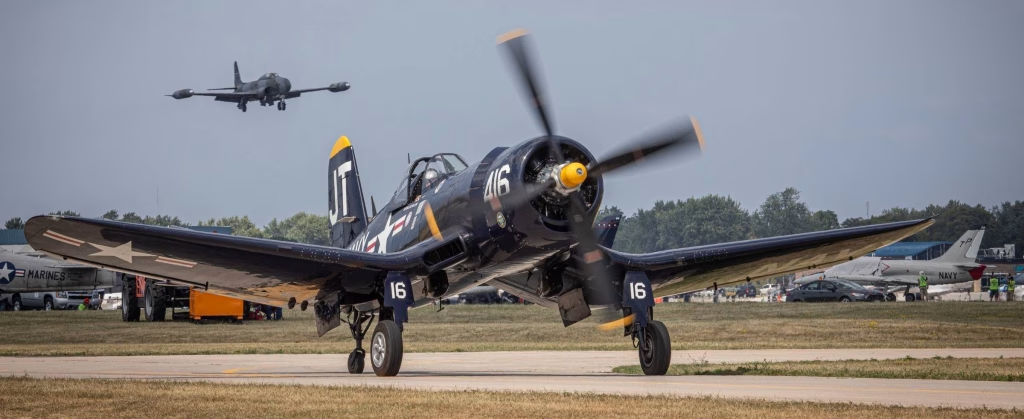
It had two big requirements: use the brand-new R-2800 Double Wasp engine as the powerplant, and be able to land on an aircraft carrier. Every other major design choice fell out of these requirements.
Its massive propeller was chosen to best harness the engine’s 2000 horsepower output for maximum thrust and speed.
This propeller needed adequate ground clearance, but just making the landing gear struts longer would leave them too weak to handle the intense forces of a carrier deck landing. The signature inverted gull wing kept the struts short and sturdy while still leaving plenty of prop clearance.
The gull wing design meant the wing met the fuselage at a right angle, substantially decreasing drag. It also allowed the oil coolers to be mounted inside the wings and even further reduce drag. And as a fun side effect, locating the coolers there meant they created a unique sound at high speeds that inspired the fighter’s nickname of “Whistling Death.”
Even ninety years later, identifying these critical guiding requirements at the start of a design effort is still some of the best time you’ll ever spend. You’ll know what you can sacrifice to achieve what actually matters. It gives your team the true reason this aircraft needs to exist at all. And honestly, that can be pretty darn motivating.